
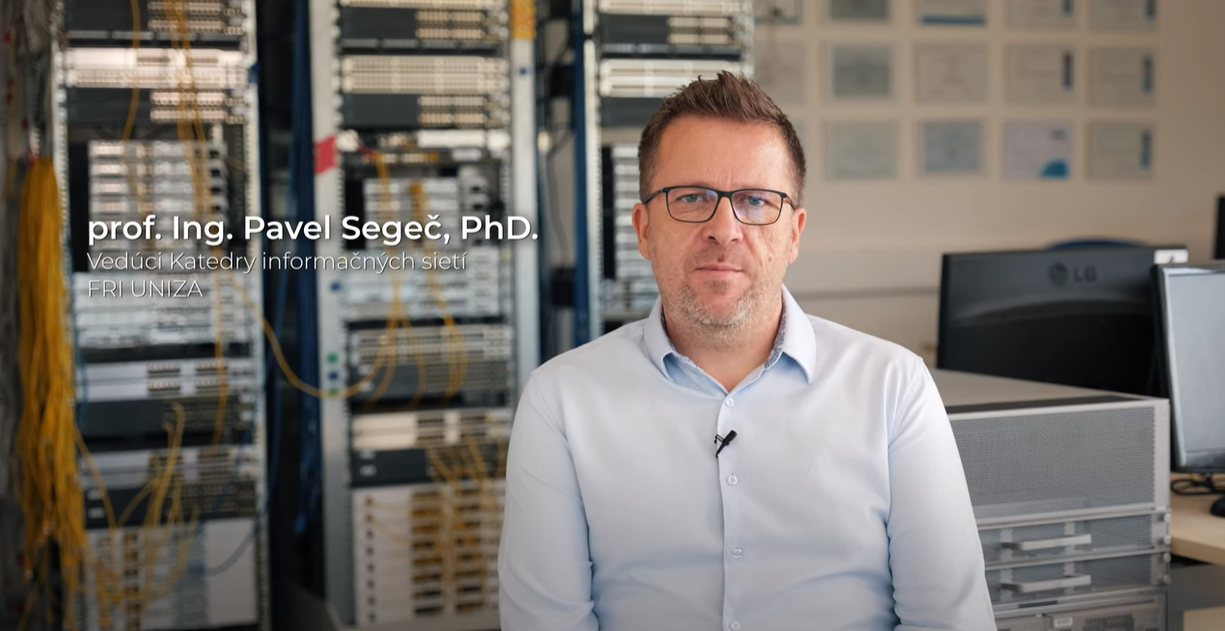
As part of the INNOSOC – Innovative & Security Operations Center project, we spoke with Prof. Ing. Pavol Segeč, PhD., head of the Department of Information Networks at the Faculty of Management Science and Informatics, UNIZA.
Professor Segeč is a key research scientist on the project, which focuses on strengthening cybersecurity in organisations and schools through innovative technologies and educating a new generation of experts.
Does cybersecurity concern everyone?
At the start of the interview, Prof. Segeč explains why the security of IT infrastructure is a pressing topic even for small organisations:
“For me, cybersecurity is a key topic today, because we live in a time when everything is interconnected, we are in an online world, and networks are becoming digital highways that enable and support our behaviour, business and other aspects of our lives.”
The role of the Faculty of Management Science and Informatics, UNIZA, in the INNOSOC project
The Faculty of Management Science and Informatics (FRI) is one of the project’s main partners and oversees both the research part and the development activities.
“Within the INNOSOC project, we provide our capacities and also our private infrastructure as a concept on which pilot deployments of the technologies in the project can be carried out,” says Professor Segeč.
The most common threats and the need for centralised protection
According to statistical data, the most common threats include phishing attacks, ransomware and APTs (Advanced Persistent Threats), in which an attacker carries out long-term espionage and monitoring in the victim’s network.
The Security Operations Center (SOC) as the core of defence
One of the main outputs of the INNOSOC project is the design and building of a Security Operations Center (SOC) – a central hub that monitors, analyses and responds to cyber incidents in real time.
“SOCs are built on three pillars: people, processes and technology,” adds Prof. Segeč.
New requirements under the NIS2 directive
In the interview, he also discussed the upcoming implementation of the NIS2 directive, which fundamentally changes cybersecurity requirements across the EU.
“Thanks to the NIS2 directive, which has been transposed into Slovak legislation, the requirements for raising the level of security and security management in companies have become stricter. So have the aspects related to reporting attacks – and it is precisely the reporting and detection of attacks that SOCs should help with.”
How SOC systems work
Finally, the professor described how such systems work in practice:
“Technologically, SOCs work on the principle of telemetric collection of large amounts of data; these data are then loaded into databases and enriched with various additional data to make it easier to detect and uncover anomalous behaviour.”
You can watch the full interview with Prof. Ing. Pavol Segeč, PhD. in the video below. In it, he explains why cybersecurity is not just a technical topic but an essential foundation for the trustworthy and stable functioning of organisations.
This article is an output of the project “Multitenant Cybersecurity Operations Center Delivered as an Open Cloud Service with Machine Learning Elements.” Project code – 09I05-03-V02-00010.